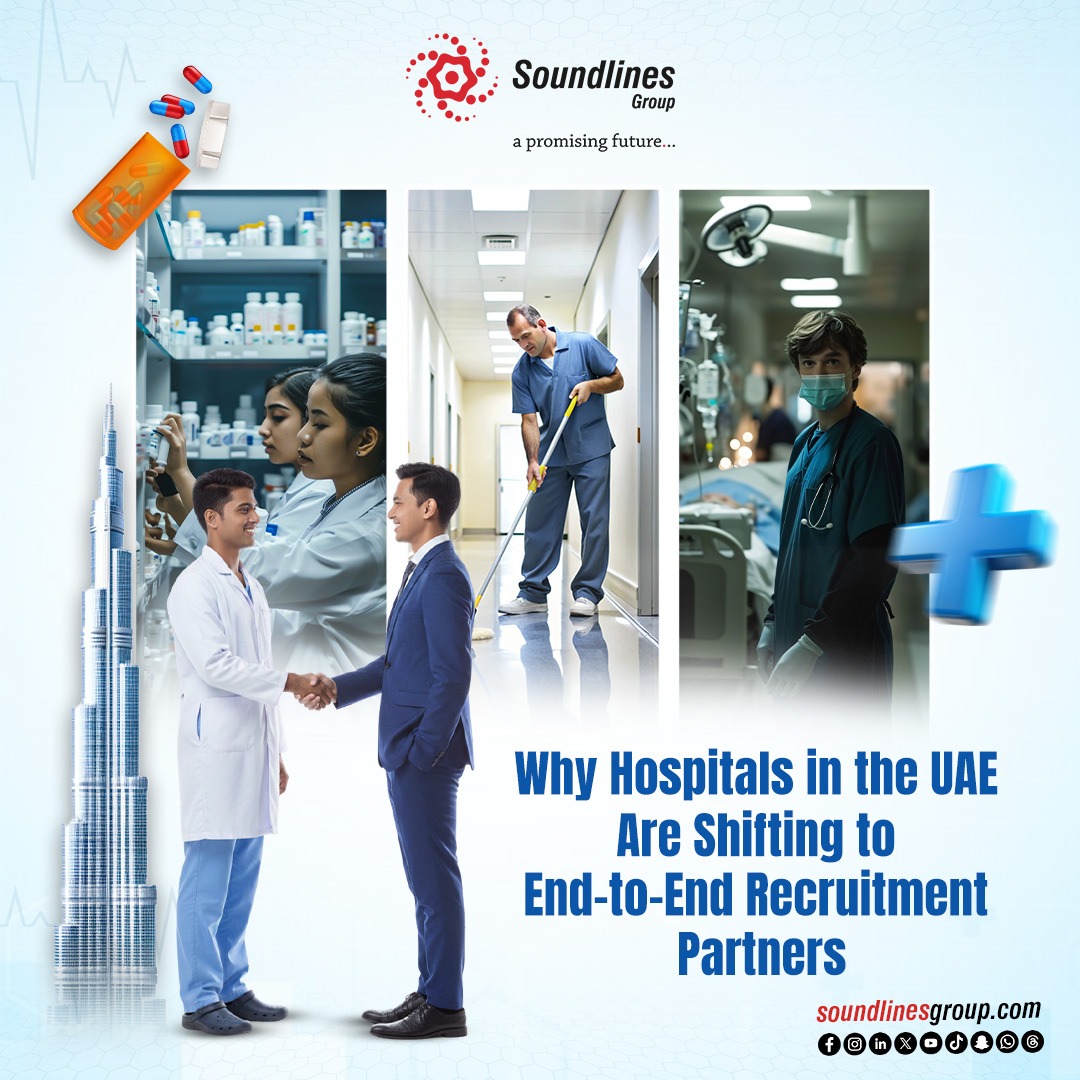
Healthcare operations in the UAE have become increasingly complex. Hospitals today manage growing patient volumes, expanding specialty services, strict regulatory frameworks, and rising expectations around care quality and operational efficiency. In this environment, traditional fragmented hiring models are no longer sufficient. Increasingly, hospitals are shifting toward end-to-end recruitment partners who can manage the full workforce lifecycle with consistency, accountability, and scale.
Table of Contents
ToggleFragmented Hiring Creates Operational Risk
Many hospitals still rely on multiple vendors for sourcing, licensing coordination, visa processing, onboarding, and accommodation logistics. While this approach may appear flexible, it often creates gaps in responsibility, inconsistent timelines, and higher operational risk.
Delays in licensing approvals, incomplete documentation, or misaligned onboarding schedules can directly impact ward readiness and service continuity. When recruitment ownership is split across multiple agencies, accountability becomes diluted, making issue resolution slower and more complex.
End-to-end recruitment partners provide a single point of responsibility across the entire hiring journey — reducing coordination friction and improving predictability.
Speed and Predictability Matter More Than Ever
Healthcare staffing is time-sensitive. Bed expansion plans, new department launches, and seasonal demand spikes require precise workforce planning. Hospitals cannot afford unpredictable hiring cycles or last-minute mobilization challenges.
End-to-end recruitment partners enable hospitals to forecast manpower pipelines accurately, align licensing timelines, and pre-plan onboarding schedules. This structured approach reduces vacancy risk, stabilizes shift coverage, and protects patient service continuity.
Predictability has become just as important as speed.
Regulatory Compliance Has Become More Complex
UAE healthcare recruitment involves multiple layers of compliance — professional licensing, credential verification, medical fitness requirements, immigration approvals, and labor regulations. Any lapse in compliance exposes hospitals to operational disruption, regulatory penalties, and reputational risk.
End-to-end recruitment partners integrate compliance into every stage of recruitment rather than treating it as a downstream activity. Documentation workflows, verification protocols, and audit readiness are embedded into the recruitment pipeline itself, giving hospitals greater confidence and transparency.
For hospitals operating under accreditation frameworks and international quality benchmarks, this structured compliance management is critical.
Workforce Quality and Retention Are Strategic Priorities
Hospitals are no longer focused solely on filling vacancies. Retention, workforce stability, and performance consistency have become strategic priorities. High turnover affects care quality, training investments, and operational morale.
End-to-end recruitment partners manage not just selection but also cultural fit, onboarding quality, accommodation alignment, grievance handling, and ongoing workforce monitoring. This integrated approach improves retention outcomes and reduces attrition-related costs over time.
Hospitals benefit from teams that integrate faster, perform consistently, and remain engaged longer.
Cost Control Through Systematic Workforce Planning
Fragmented hiring often leads to inflated emergency recruitment costs, repeated mobilization expenses, and inefficiencies in documentation handling. Over time, these hidden costs accumulate significantly.
By consolidating recruitment under a single end-to-end partner, hospitals gain better cost visibility, standardized pricing structures, and more efficient resource utilization. Workforce planning becomes proactive rather than reactive — improving budget control without compromising quality.
Scalability for Growth and Expansion
UAE hospitals are continuously expanding — adding new specialties, increasing bed capacity, and entering new geographic zones. Recruitment strategies must scale seamlessly with these ambitions.
End-to-end recruitment partners bring infrastructure, international sourcing networks, compliance systems, and deployment capabilities that allow hospitals to scale workforce volumes without operational strain.
This scalability enables leadership teams to focus on clinical excellence and patient outcomes rather than manpower logistics.
A Strategic Shift, Not a Tactical Change
The move toward end-to-end recruitment partnerships reflects a broader shift in healthcare management — from transactional hiring toward strategic workforce governance. Hospitals increasingly view recruitment as a long-term operational pillar rather than a short-term administrative function.
At Soundlines Group, healthcare recruitment is structured as a complete workforce lifecycle solution. With over 25 years of international recruitment experience and operations across 23 countries, Soundlines supports UAE hospitals through sourcing, credential verification, regulatory compliance, mobilization, and post-deployment workforce management — creating stable, scalable manpower pipelines aligned with hospital growth strategies.
As healthcare delivery in the UAE continues to evolve, end-to-end recruitment partnerships are becoming a cornerstone of sustainable hospital operations — enabling resilience, compliance, and long-term workforce stability.