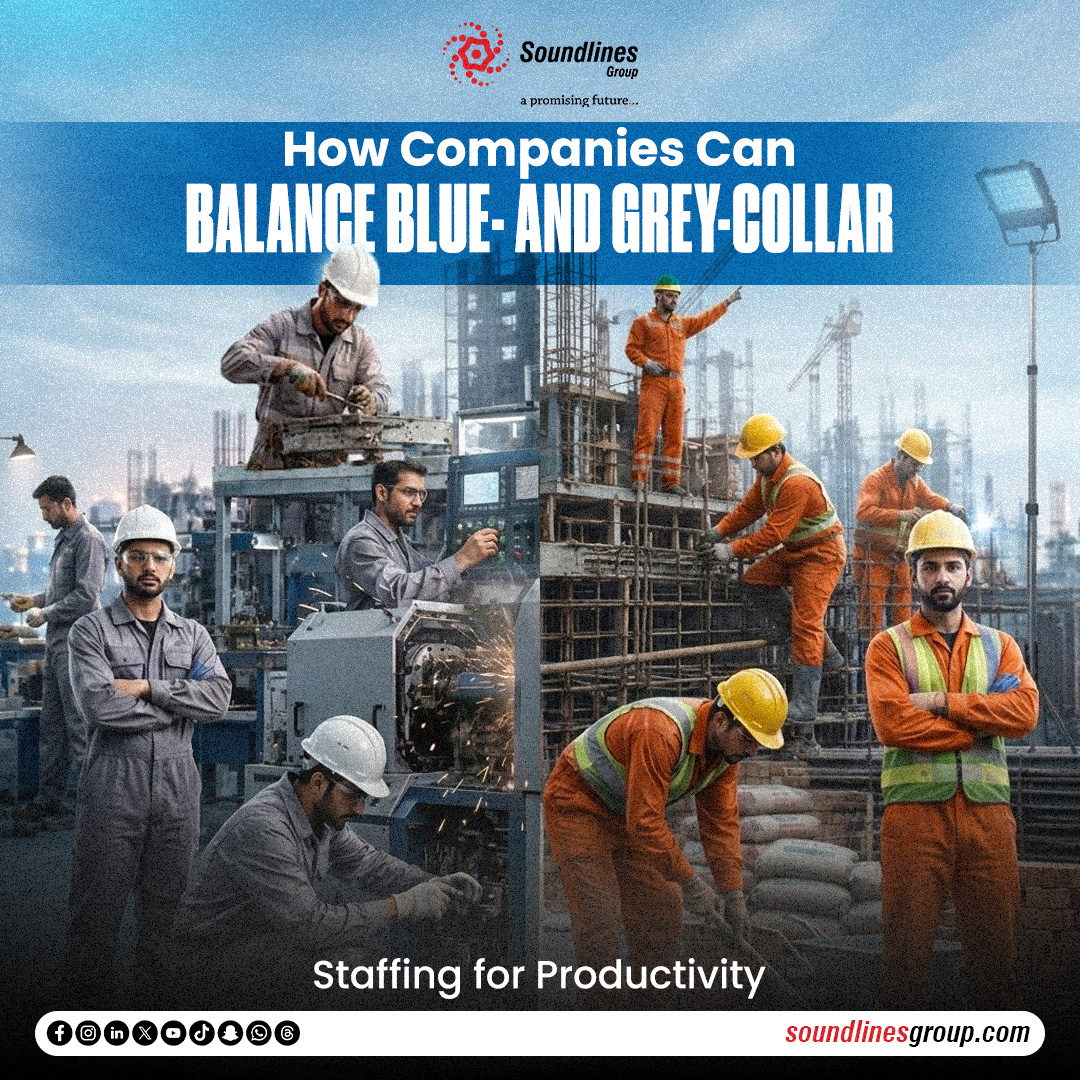
Most productivity issues don’t start on the shop floor. They start with how teams are structured.
A company may have enough workers on paper, yet still struggle with delays, rework, or inconsistent output. In many cases, the root cause is not a shortage—it is an imbalance between execution and coordination.
This is where the relationship between the blue-collar and grey-collar workforce becomes critical.
Table of Contents
ToggleWhen Execution Outruns Structure
In high-demand environments, hiring usually begins with execution roles.
Projects expand. Operations scale. The immediate need is to get more hands on the ground—technicians, operators, labour, and support staff. Blue-collar hiring increases quickly.
Initially, this works.
But as teams grow, problems begin to surface:
- Work slows despite more manpower
- Instructions are not followed consistently
- Quality varies across teams
- Supervisors become stretched
The issue is not capability. It is control.
Too many execution roles without enough structured oversight.
When Structure Outruns Execution
The opposite imbalance is equally common.
Some organisations focus heavily on control—adding supervisors, coordinators, and mid-level roles without expanding execution teams proportionately.
This creates a different set of issues:
- Decision-making slows down
- Teams wait for instructions
- Productivity drops despite a structured hierarchy
Here, the system exists, but the capacity to deliver does not.
Productivity Lives in the Balance
The real efficiency lies in how both segments are aligned.
Blue-collar workforce drives output.
The grey-collar workforce drives direction.
When the ratio is right:
- Work moves faster with fewer errors
- Teams operate with clarity
- Supervision becomes effective, not reactive
When the ratio is off, even strong teams struggle.
Why This Balance Is Hard to Maintain
The challenge is that workforce needs are not static.
They shift based on:
- Project phase
- Scale of operations
- Type of industry
- Level of complexity
A construction site in early stages needs a different structure compared to finishing stages. A manufacturing unit scaling production needs different supervision compared to steady-state operations.
Without continuous adjustment, imbalance becomes inevitable.
Moving Beyond Headcount Thinking
One of the biggest limitations in workforce planning is focusing only on numbers.
“How many people do we need?” is the wrong starting point.
A better question is:
“How should teams be structured to perform efficiently?”
This shifts the focus from quantity to design.
It leads to decisions such as:
- How many workers per supervisor
- Which roles require technical oversight
- Where coordination adds measurable value
The Cost of Getting It Wrong
An imbalance between blue and grey-collar staffing leads to:
- Rework and delays
- Increased supervision effort
- Lower overall productivity
- Higher operational costs
These costs are often indirect, but they compound over time.
Building a More Stable Workforce System
Companies that manage this well don’t rely on reactive hiring.
They build systems that allow:
- Role-specific hiring based on operational needs
- Consistent ratios between execution and supervision
- Flexibility to adjust the workforce as demand changes
This approach creates stability—not just in the workforce, but in output.
Conclusion
Productivity is not just about effort—it is about structure.
Balancing blue and grey collar workforce is what allows organisations to scale without losing control. It ensures that execution and coordination work together, rather than against each other.
With 25+ years of experience and a presence across 22+ international locations, Soundlines Group supports businesses with structured workforce solutions—helping them design balanced teams that improve productivity and operational efficiency at scale.